Delivering Excellence. Honoring Every Commitment.
ERAGON TEAM
Dissolved Air Flotation (DAF) is widely used in industrial wastewater treatment to remove suspended solids, oil, grease, and lightweight particles that are difficult to separate by gravity settling alone. It is commonly installed before biological treatment, filtration, or membrane systems to improve downstream treatment performance.
However, not every wastewater stream requires DAF. The right choice depends on the type of contaminants, wastewater variability, required effluent quality, and the performance of alternative separation technologies.
How Does a DAF System Work?
A dissolved air flotation system uses fine air bubbles to separate contaminants from wastewater. Pressurized water saturated with air releases microscopic bubbles when the pressure drops. These bubbles attach to suspended particles, oil droplets, or chemical flocs, allowing them to rise to the surface for removal by a skimming mechanism.
A typical DAF process includes:
1. Wastewater conditioning: Screening or equalization helps stabilize the incoming flow.
2. Chemical dosing, if required: Coagulants and flocculants help form particles that can be separated more effectively.
3. Air dissolution and release: Fine bubbles are introduced into the flotation zone.
4. Flotation and skimming: Contaminants rise to the surface and are removed as float sludge.
5. Clarified water collection: The treated water moves to the next treatment stage.
Chemical dosing requirements depend on wastewater characteristics. Jar testing or pilot testing may be necessary to establish suitable operating conditions.
Where Are DAF Systems Used?
DAF is particularly useful when wastewater contains oil, grease, lightweight suspended solids, or flocs that do not settle readily.
| Industry | Typical wasteter challenge | Potential role of DAF |
| Food and beverage | Fats, oils, grease, and suspended organic matter | Pretreatment before biological treatment |
| Metal finishing and electroplating | Oil, suspended solids, and precipitated metal hydroxide flocs | Solid-liquid separation after suitable chemical treatment |
| Oil and petrochemical | Free or dispersed oil and suspended particles | Oil and solids separation before downstream treatment |
| Textile and dyeing | Fibres, suspended solids, and floatable flocs | Pretreatment where flotation tests demonstrate suitability |
| Industrial water reuse | Residual oil and suspended solids | Pretreatment before filtration or membrane systems |
DAF does not remove all contaminants. Dissolved salts generally require other separation processes, while dissolved heavy metals may need chemical precipitation before flotation.
DAF for Oil and Grease Removal
DAF is often considered for oily wastewater because fine bubbles can attach to oil droplets and carry them to the surface. However, free oil and emulsified oil behave differently.
Free oil is generally easier to separate, while stable emulsions may require chemical conditioning. Surfactants, cleaning chemicals, and changes in production conditions can all affect flotation performance.
For this reason, equipment selection should consider the actual form and concentration of oil rather than simply whether oil is present.
DAF for Suspended Solids
DAF can also separate lightweight suspended solids and flocs produced during physicochemical treatment. In metal finishing applications, for example, chemical precipitation may generate metal hydroxide flocs that need to be removed before further treatment.
The result depends on floc characteristics, chemical dosage, air-to-solids ratio, and hydraulic conditions. If the solids are dense and settle readily, a lamella clarifier may be a more suitable option.
DAF vs. Sedimentation: Which Is Better?
DAF and sedimentation both separate solids from water, but they work differently.
| Factor | DAF system | Sedimentation or lamella clarifier |
| Separation principle | Fine bubbles lift particles to the surface | Gravity causes particles to settle |
| Typical strengths | Oil, grease, lightweight solids, and suitable flocs | Dense, readily settleable solids |
| Energy requirements | Requires pressurization and air-related equipment | Often relies more heavily on gravity |
| Key design considerations | Air dissolution, recycle flow, skimming, and chemical dosing | Settling characteristics, hydraulic loading, and sludge removal |
Neither technology is universally better. The choice depends on wastewater characteristics, the required outlet quality, installation constraints, and operating costs.
For a more detailed comparison, see ERAGON's article on choosing between DAF and lamella clarifiers.
Five Criteria for Selecting an Industrial DAF System
1. Flow Rate and Operating Pattern
Average flow rate is an important starting point, but peak flow and production schedules also matter. Batch discharges or short periods of high pollutant loading can affect flotation performance.
Where wastewater flow or quality fluctuates significantly, equalization may be necessary before the DAF unit.
2. Influent Water Quality
Representative wastewater analysis helps determine the appropriate configuration. Key parameters include:
If wastewater quality changes between production batches, sampling should capture these variations wherever possible.
3. Required Effluent Quality
The target outlet quality determines what DAF needs to achieve and which treatment stages should follow.
For example, a DAF unit installed before biological treatment may primarily remove oil and suspended solids. If the effluent feeds an ultrafiltration or reverse osmosis system, residual solids and oil carryover become important considerations.
DAF alone should not be expected to meet a final discharge or reuse target when significant dissolved pollutants remain.
4. Chemical Consumption and Sludge Handling
Coagulation and flocculation can improve flotation when fine particles or stable emulsions are difficult to separate. However, unsuitable dosing can increase chemical costs, sludge production, or operating instability.
The design should consider the complete sludge-handling route, including concentration, dewatering, and disposal requirements.
5. Footprint and System Integration
Available installation space, tank depth, maintenance access, and connections to existing equipment can influence the selection.
A shallow DAF system may be worth evaluating where footprint or installation height is constrained. Its suitability still depends on the required capacity, solids loading, hydraulic arrangement, and wastewater characteristics.
For industrial applications requiring compact flotation and solids separation, ERAGON's High-Efficiency Shallow DAF System is one configuration to consider. Final sizing and configuration should be based on project-specific requirements.
DAF in Metal Surface Treatment
In metal surface treatment and component cleaning, wastewater may contain oil, suspended solids, and fine flocs generated during chemical treatment. When these particles do not settle consistently, conventional sedimentation alone may not provide stable solid-liquid separation.
For an application with a preliminary design flow rate of 25 m³/h, a dissolved air flotation (DAF) system can be considered as part of the wastewater pretreatment process.
A potential treatment configuration is:
Equalization → Coagulation and Flocculation (if required) → DAF → Subsequent Filtration or Further Treatment
The final configuration depends on wastewater characteristics and the required effluent quality. Chemical conditioning may help improve the separation of fine particles, while DAF can remove suitable floatable solids and oil before the water enters downstream treatment.
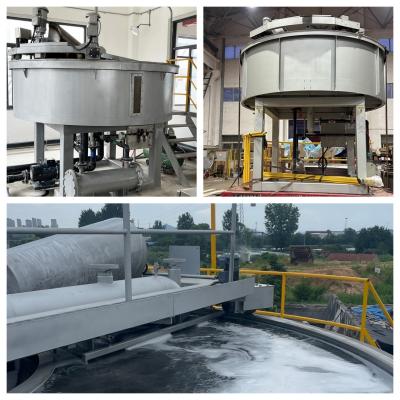
This application illustrates why DAF selection should consider both the wastewater characteristics and the requirements of subsequent treatment stages, rather than flow rate alone.
FAQ
Can a DAF system remove COD from industrial wastewater?
DAF can reduce COD associated with suspended solids, oil, or floatable flocs. It is generally less effective against dissolved organic compounds, which may require biological or other treatment processes.
Does every DAF system require coagulants and flocculants?
No. Chemical dosing depends on the wastewater composition and separation objectives. Testing can help determine whether dosing is needed and establish suitable operating conditions.
How is DAF system capacity determined?
Capacity depends on flow rate, oil and solids loading, wastewater characteristics, required effluent quality, and the selected flotation design. Systems with the same flow rate may require different configurations because their separation requirements differ.
Choosing an industrial DAF system is a process-design decision, not just a capacity calculation. Reliable selection starts with representative wastewater data, identifies which contaminants can be removed by flotation, and considers how the clarified water and separated sludge will be managed downstream.





Leave a Message
Scan to wechat :

Scan to Whatsapp :