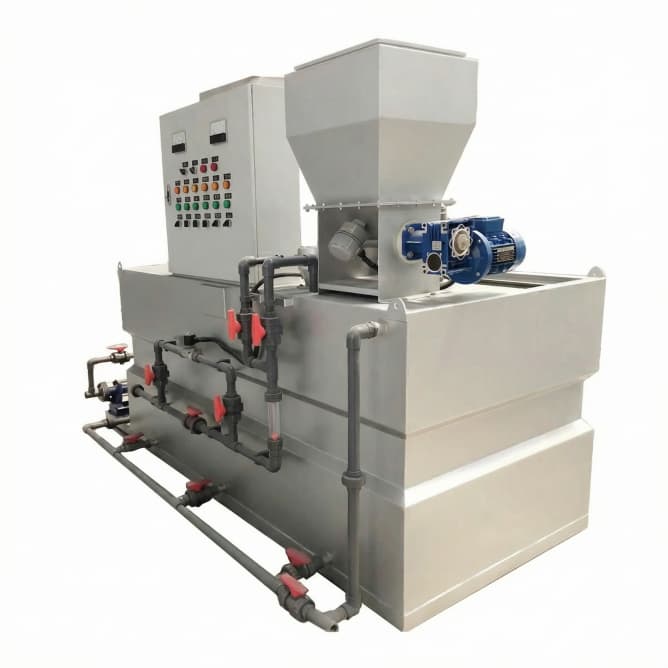
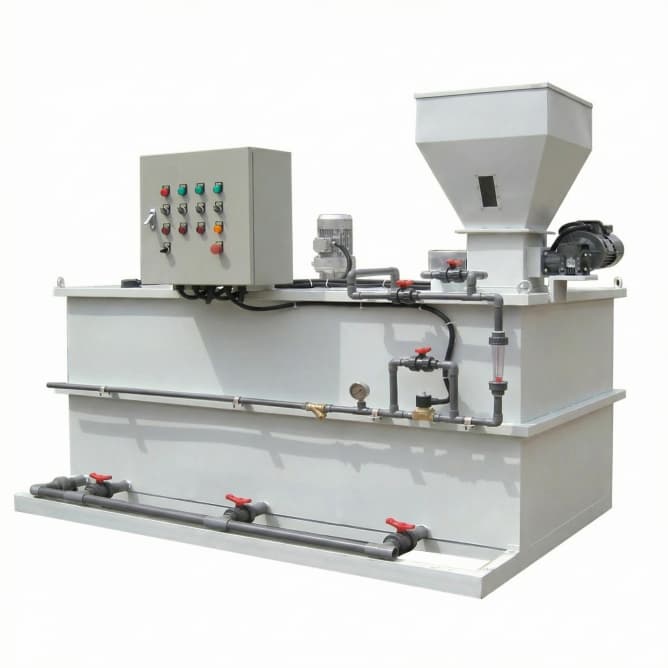
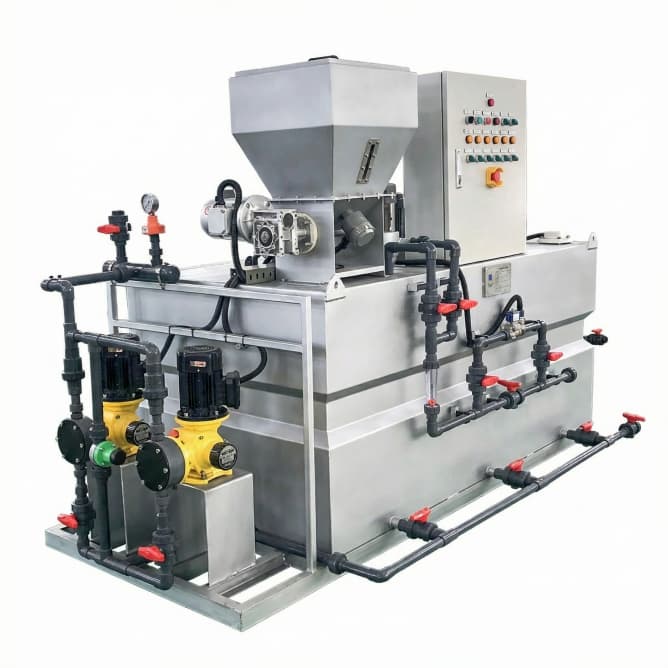
EET Automatic Polymer Preparation & Dosing System is designed for accurate polymer dissolution, aging, and dosing in water and wastewater treatment processes.
It ensures stable polymer concentration, consistent dosing accuracy, and reliable flocculation performance under continuous operation.
EET Automatic Polymer Preparation & Dosing System
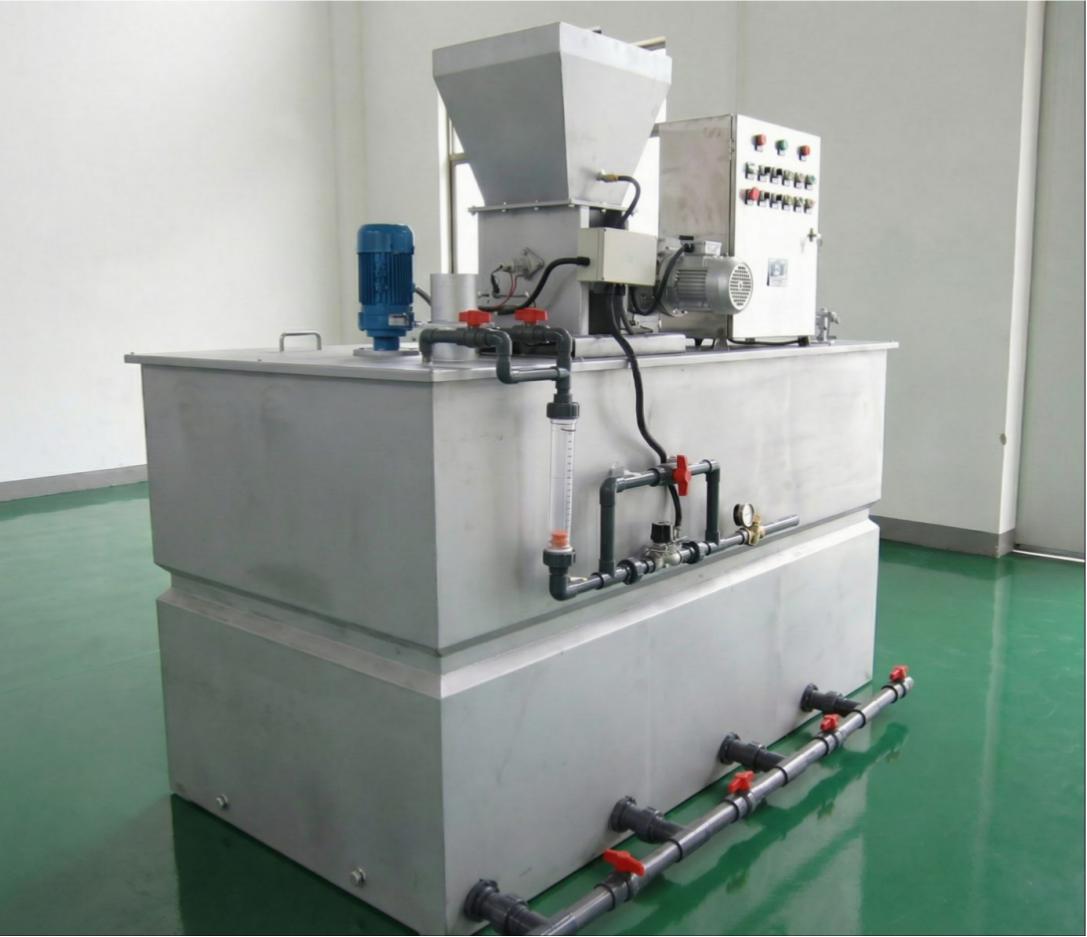
This system integrates polymer powder feeding, wetting, dissolution, aging, and dosing into a compact, automated unit. The three-chamber configuration ensures sufficient dissolution time and solution homogeneity, delivering consistent polymer performance even under fluctuating operating conditions.
It is widely applied as a critical auxiliary unit for sludge dewatering, flotation, sedimentation, and membrane pretreatment systems.
Key Features
System Placement
• Installed upstream of coagulation/flocculation tanks for chemical conditioning
• Used in pretreatment before UF/RO/NF systems for antiscalant or disinfectant dosing
• Integrated with pH adjustment tanks and neutralization systems
• Applied in oxidation/reduction and heavy metal removal process stages
Typical Applications
• Industrial wastewater treatment (electroplating, chemical, electronics, textile, etc.)
• Municipal water treatment and clarification systems
• Membrane system pretreatment (UF/RO/NF) chemical conditioning
• pH adjustment and neutralization for process wastewater
• Coagulant/flocculant dosing for suspended solids and turbidity removal
• Oxidant dosing for color removal, COD reduction, and disinfection
Automatic Polymer Preparation & Dosing System Process Overview
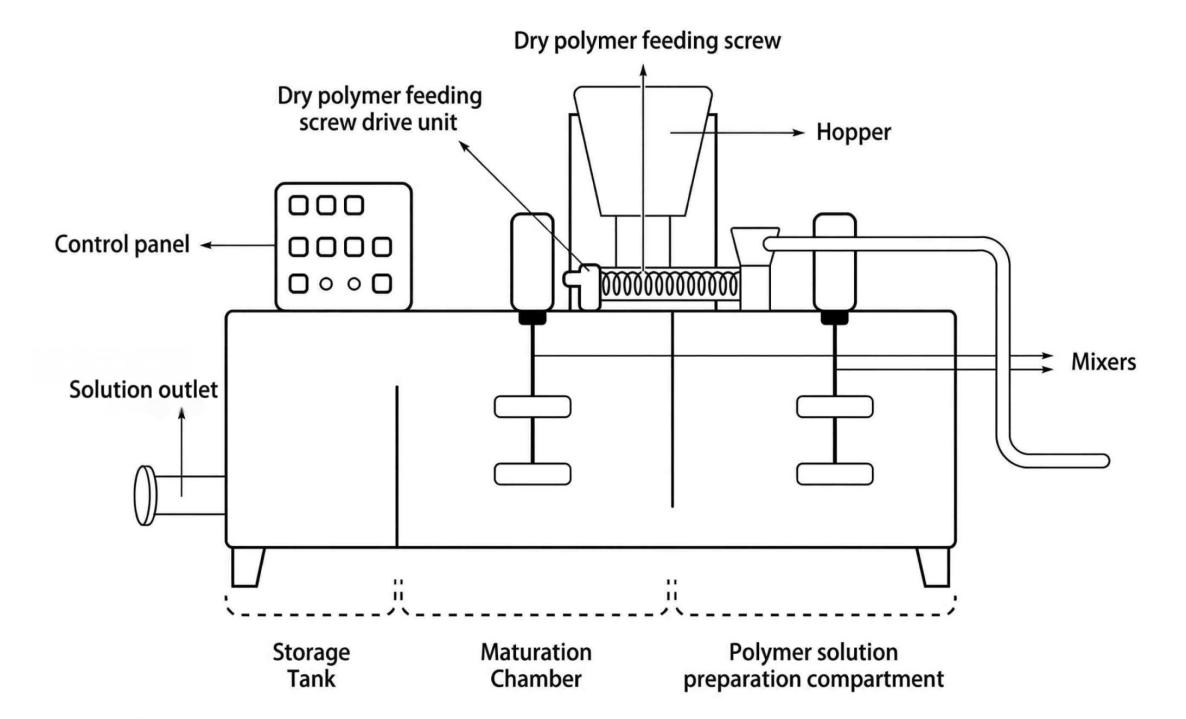
Step 1 – Polymer Feeding
Powder or liquid polymer is accurately fed into the preparation chamber.
Step 2 – Dissolution & Mixing
Polymer is mixed with dilution water to form a homogeneous solution.
Step 3 – Aging Process
The solution is retained in the aging tank to activate polymer properties.
Step 4 – Metered Dosing
Prepared polymer solution is continuously dosed to the treatment process.
Step 5 – Automatic Control
Dosing rate adjusts automatically based on system operation requirements.
| Model |
Preparation Capacity L/h |
Inlet Flow Rate m³/h |
Powder Feeder Power kW |
Mixer Power kW |
Dimensions L × W × H, mm |
Approx. Weight kg |
| EET-500 | 500 | ~0.75 | 0.25 | 0.4 | 1750x850x1700 | 1500 |
| EET-1000 | 1000 | ~1.5 | 0.25 | 0.4 | 2000x1000x1700 | 2500 |
| EET-1500 | 1500 | ~2.2 | 0.25 | 0.4 | 2400x1390x1700 | 3700 |
| EET-2000 | 2000 | ~3 | 0.25 | 0.4 | 2440x1200x1900 | 4800 |
| EET-3000 | 3000 | ~4.5 | 0.25 | 0.75 | 2840x1650x1990 | 7000 |
| EET-4000 | 4000 | ~6 | 0.25 | 0.75 | 3000x1200x1900 | 9200 |
| EET-5000 | 5000 | ~8 | 0.25 | 0.75 | 3000x1500x1900 | 12500 |
| EET-8000 | 8000 | ~12 | 0.25 | 1.1 | 4000x1500x2200 | 16000 |
| EET-10000 | 10000 | ~15 | 0.25 | 1.1 | 5500x2200x2200 | 18000 |
Note: Final configuration may vary based on feed water quality and site conditions.





Leave a Message
Scan to wechat :

Scan to Whatsapp :

 Product categories